Mpox — formerly known as monkeypox — re-emerged as a significant public health concern in 2022, when a global outbreak spread to countries where the virus had not previously circulated, including the United States. Florida recorded among the highest case counts of any U.S. state during that outbreak, and the virus continues to circulate at low levels. Understanding mpox in Fort Myers, Florida — what it is, how it spreads, what symptoms to watch for, and where to access care — remains an important part of sexual and infectious disease health awareness in Southwest Florida.
At Florida Infectious Disease Care, our board-certified specialists are experienced in evaluating and managing mpox and can provide testing, treatment, and vaccination guidance for patients in Fort Myers and throughout the region.
What Is Mpox?
Mpox is a viral infection caused by the monkeypox virus, a member of the Orthopoxvirus genus — the same family as smallpox, though considerably less severe. The virus was first identified in humans in 1970 in the Democratic Republic of Congo and has been endemic in parts of Central and West Africa for decades. The 2022 global outbreak introduced a new pattern of primarily human-to-human transmission through close physical contact, shifting the epidemiology significantly from the original animal-to-human model.
According to the CDC, two clades (strains) of mpox exist. Clade II — the strain responsible for the 2022 global outbreak — typically causes milder illness. Clade I, circulating primarily in Central Africa, is associated with higher severity and has prompted concern from global health authorities including the WHO.
How Does Mpox Spread?
The primary mode of mpox transmission in the 2022 and ongoing outbreaks has been through direct, prolonged skin-to-skin contact with an infected person — particularly during sexual activity. However, mpox is not classified exclusively as a sexually transmitted infection. It can spread through:
- Direct contact with mpox rash, sores, or scabs on an infected person
- Contact with bodily fluids — saliva, respiratory secretions, or genital fluids — from an infected person
- Touching objects, fabrics, or surfaces recently contaminated by someone with mpox
- Respiratory droplets during prolonged face-to-face contact
- From an infected animal through a bite or scratch, or contact with animal products
While gay, bisexual, and other men who have sex with men were disproportionately affected during the 2022 outbreak, anyone can acquire mpox through close contact with an infected person. Mpox is not a disease exclusively affecting any one group.
Symptoms of Mpox
Mpox symptoms typically begin 3 to 17 days after exposure and may include:
- Fever, chills, and headache — often appearing before the rash
- Muscle aches and exhaustion
- Swollen lymph nodes — a distinguishing feature from other pox-like illnesses
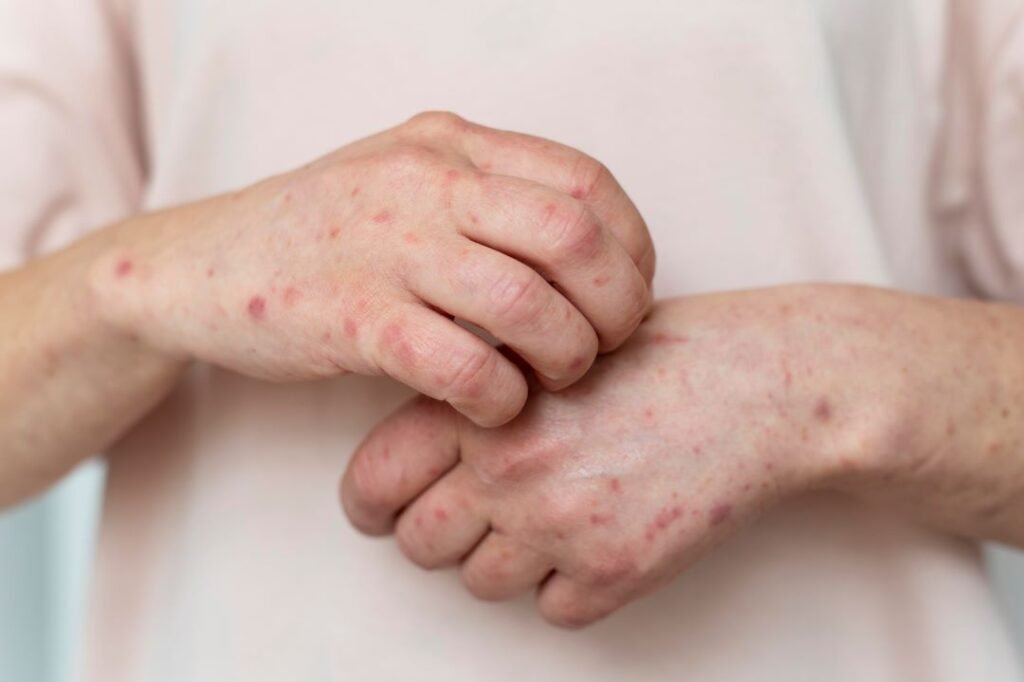
- A characteristic rash that progresses through distinct stages: flat spots (macules), raised bumps (papules), fluid-filled blisters (vesicles), pus-filled blisters (pustules), and finally scabs
The rash associated with the 2022 outbreak frequently presented in the genital, anal, or oral region, or on the hands and face, and in some cases appeared without the classic preceding fever. Lesions may be painful, particularly when they involve mucous membranes. The illness typically lasts two to four weeks and resolves without specific treatment in mild cases.
However, severe mpox can cause extensive painful lesions, secondary bacterial skin infections, eye involvement, and in rare cases, encephalitis or death — particularly in immunocompromised patients.
Mpox Testing in Fort Myers FL
Mpox is diagnosed through PCR testing of material collected from skin lesions. If you have a new unexplained rash — particularly following potential close contact with someone who may have mpox — contact Florida Infectious Disease Care for evaluation. Do not attend the appointment without calling first, so we can arrange appropriate infection control precautions for your visit.
Testing is most reliable when lesions are present and sampled correctly. Your specialist will collect samples from at least two lesions using swabs and submit them to an appropriate laboratory for PCR confirmation.
Mpox Treatment in Fort Myers Florida
Most patients with mild mpox recover with supportive care — pain management, wound care for lesions, and monitoring for bacterial superinfection. Antiviral medication is available for patients at higher risk of severe disease.
Tecovirimat (TPOXX) is an antiviral medication approved for the treatment of smallpox that has also been used under expanded access protocols for mpox in patients who are immunocompromised, have severe disease, or have extensive or anatomically complicated lesions. Our infectious disease specialists can evaluate eligibility for antiviral treatment and coordinate access through appropriate channels.
Mpox Vaccination in Southwest Florida
The JYNNEOS vaccine — a two-dose vaccine given 28 days apart — provides effective protection against mpox. It is recommended for individuals at higher risk of mpox exposure, including gay and bisexual men with multiple partners, people who have had a recent STI, and close contacts of confirmed mpox cases.
Vaccination can also be given after a known exposure (post-exposure prophylaxis) within four days of exposure to prevent illness, or within 14 days to reduce severity. Our team can advise on vaccine eligibility and facilitate access. Contact our clinic to discuss your individual situation.
Frequently Asked Questions
Q: Is mpox the same as chickenpox or smallpox?
No. Mpox, chickenpox (varicella), and smallpox are caused by different viruses, though mpox and smallpox belong to the same viral family. Chickenpox is caused by the varicella-zoster virus and is a completely separate infection. Mpox is generally milder than smallpox but can be more serious than chickenpox, particularly in immunocompromised individuals.
Q: Can I get mpox from someone who does not have a visible rash?
The mpox virus is most efficiently transmitted when lesions are present. However, transmission in the prodromal phase — before the rash appears — is possible through respiratory secretions or bodily fluid contact. This is one reason why early isolation after symptom onset is important, even before lesions become visible.
Q: How long am I contagious with mpox?
A person with mpox is considered contagious from the onset of symptoms until all lesions have fully healed and a fresh layer of skin has formed — which typically takes two to four weeks. During this entire period, close skin contact and sexual activity should be avoided to prevent transmission to others.
Q: If I have had the smallpox vaccine, am I protected against mpox?
Older smallpox vaccines do provide cross-protective immunity against mpox. People vaccinated against smallpox before vaccination programs ended in the 1970s and early 1980s likely retain some degree of protection. However, this protection wanes over time and is not complete. The JYNNEOS vaccine is the currently recommended option for mpox prevention for eligible individuals.
Ready to Take the Next Step?
At Florida Infectious Disease Care in Fort Myers, our board-certified infectious disease specialists provide expert, compassionate, and completely confidential care for every patient. Call us at 239-245-8223 or visit us at 14192 Metropolis Ave, Fort Myers, FL 33912.
Book your appointment online at floridaidcare.com/make-an-appointment or find us on Google Maps. You deserve expert infectious disease care — and we are here when you need us.
