
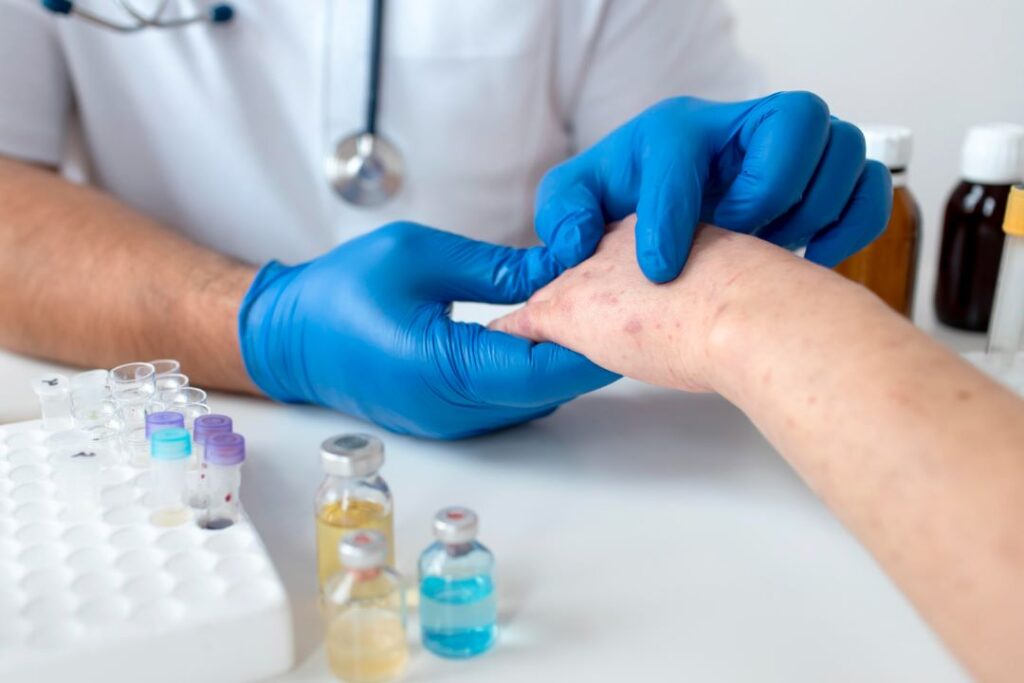
Skin infections are among the most common reasons patients visit an infectious disease specialist in Southwest Florida. The combination of Florida’s warm, humid climate, active outdoor lifestyle, and year-round presence of insects and environmental bacteria creates conditions in which skin infections develop easily — and in some cases, progress rapidly to serious illness.
Understanding the spectrum of skin infection treatment in Fort Myers, FL — from straightforward cellulitis to drug-resistant MRSA — can help you recognize warning signs early and seek the right level of care before a manageable infection becomes a medical emergency. At Florida Infectious Disease Care, our specialists manage the full range of skin and soft tissue infections, from initial diagnosis through complex IV antibiotic treatment.
The Most Common Skin Infections in Southwest Florida
Cellulitis
Cellulitis is a bacterial infection of the skin and the soft tissue beneath it. It typically presents as a spreading area of redness, warmth, swelling, and tenderness — most commonly on the lower legs. Cellulitis is usually caused by Streptococcus pyogenes or Staphylococcus aureus and typically responds well to oral antibiotics when diagnosed and treated early.
In Fort Myers and surrounding areas, cellulitis is particularly common after insect bites, minor cuts or scrapes, and foot injuries — all of which are frequent in Florida’s outdoor environment. Patients with diabetes, lymphedema, or chronic venous insufficiency are at significantly higher risk of both developing cellulitis and experiencing recurrences.
Abscesses and Boils
A skin abscess is a localized collection of pus within the skin, typically caused by Staphylococcus aureus. Abscesses present as tender, fluctuant (fluid-filled) lumps that may be red and warm. The primary treatment is incision and drainage — antibiotics alone are generally insufficient for draining an abscess. What concerns infectious disease specialists is that a growing proportion of community abscesses in Florida are caused by MRSA rather than antibiotic-susceptible staph, requiring specific antibiotic selection after drainage.
MRSA Skin Infections
MRSA — methicillin-resistant Staphylococcus aureus — is a drug-resistant bacterium that has become increasingly common in community settings throughout Southwest Florida. MRSA skin infections often begin as what appears to be a spider bite: a red, painful, swollen lesion that grows rapidly and may develop a central pustule or area of necrosis.
The critical difference between MRSA and ordinary staph skin infections is that standard first-line antibiotics such as amoxicillin, dicloxacillin, and cephalexin have no activity against MRSA. Prescribing these antibiotics for an MRSA infection creates the appearance of treatment while allowing the infection to progress unchecked. This is one of the most common reasons MRSA infections escalate to serious illness.
Necrotizing Fasciitis
Necrotizing fasciitis — sometimes called flesh-eating bacteria — is a rare but life-threatening skin and soft tissue infection that spreads rapidly along the fascial planes beneath the skin. It can be caused by a single organism or a mixed infection and is characterized by severe pain out of proportion to the skin appearance, rapidly spreading redness or discoloration, fever, and systemic toxicity. Necrotizing fasciitis is a surgical emergency. If you or someone near you develops these features, call 911 immediately.
Warning Signs That a Skin Infection Is Becoming Serious
Most minor skin infections can be monitored at home after initial evaluation. However, the following signs require immediate medical attention:
- Red streaks extending from the infected area — a sign of spreading infection toward the lymphatic system
- Rapid expansion of the red, swollen area despite antibiotic treatment
- Fever above 101°F accompanying a skin infection
- Severe pain that seems disproportionate to the size of the infection
- Skin that develops a dusky, purple, or black discoloration
- Blistering or breakdown of the skin surface
- The patient begins to feel systemically unwell, confused, or extremely fatigued
If any of these signs are present, do not wait for a scheduled appointment. Go to an emergency room or call 911 for rapidly deteriorating presentations.
Skin Infection Treatment in Fort Myers FL: What to Expect
At Florida Infectious Disease Care, skin infection evaluation begins with a thorough assessment of the wound or lesion, your medical history, and any prior antibiotic treatment. When appropriate, we perform wound cultures or needle aspiration to identify the specific causative organism and determine its antibiotic sensitivity profile.
When susceptible organisms are identified, oral antibiotics remain the preferred approach. However, for MRSA, deep soft tissue involvement, immunocompromised patients, or any wound that has failed to respond to initial therapy, we may recommend IV antibiotic therapy through our outpatient infusion center — allowing you to receive hospital-level treatment without a hospital admission.outpatient infusion center
Prevention of Skin Infections in Southwest Florida
Florida’s environment makes complete avoidance of skin injuries impossible, but certain practices significantly reduce infection risk:
- Clean and cover all cuts, scrapes, and insect bites promptly with soap and water and an appropriate dressing
- Avoid scratching insect bites, which introduces bacteria from under the fingernails
- Shower immediately after swimming in natural bodies of water — lakes, rivers, and the ocean all harbor bacteria capable of causing skin infections
- Wear protective footwear when working outdoors or in areas with potential foot injury risk
- Keep blood glucose well controlled if you have diabetes — elevated blood sugar significantly impairs the immune response to skin bacteria
- Do not attempt to squeeze or drain a skin abscess at home — this can spread the infection and makes proper drainage more difficult
Frequently Asked Questions
Q: How do I know if my skin infection is MRSA or regular staph?
You cannot reliably distinguish MRSA from susceptible staph based on appearance alone. The only reliable method is a wound culture from the infected site. If you have a skin infection that is not improving after 48 to 72 hours of standard antibiotics, a culture should be obtained and your antibiotic reconsidered. This is particularly important in Fort Myers, where community MRSA rates are significant.
Q: Can I treat cellulitis at home with over-the-counter products?
No. Cellulitis is a bacterial infection that requires prescription antibiotic treatment. Over-the-counter antiseptic creams and washes may help clean superficial wounds but cannot treat established cellulitis. Untreated or inadequately treated cellulitis can progress to deeper tissue infection, bacteremia, or sepsis. Always seek medical evaluation for spreading skin redness or warmth.
Q: Can skin infections spread to my bones?
Yes. A skin or soft tissue infection that is not adequately treated can spread through the bloodstream to bone — causing osteomyelitis — or to joints, causing septic arthritis. Both are serious conditions requiring prolonged IV antibiotic therapy and, in some cases, surgical intervention. This is one of the most important reasons to seek prompt and appropriate treatment for any skin infection that does not respond quickly to initial therapy.
Q: My skin infection keeps coming back in the same spot. Why?
Recurrent skin infections in the same location often indicate an underlying factor that predisposes that area to infection — such as a hair follicle abnormality, a small retained foreign body, impaired lymphatic drainage, or a local immune deficiency. In the case of recurrent MRSA skin infections, the patient may also be colonized with MRSA in their nose or on their skin and require decolonization therapy. An infectious disease specialist can evaluate and address these underlying factors.
Ready to Take the Next Step?
At Florida Infectious Disease Care in Fort Myers, our board-certified infectious disease specialists provide expert, compassionate, and completely confidential care for every patient. Call us at 239-245-8223 or visit us at 14192 Metropolis Ave, Fort Myers, FL 33912.
Book your appointment online at floridaidcare.com/make-an-appointment or find us on Google Maps. You deserve expert infectious disease care — and we are here when you need us.
